What's a "Callsign"?
Anyone who wants to transmit a radio or television signal in the United States must obtain a license from the Federal Communications Commission (FCC). The FCC issues a short series of letters and numbers to uniquely identify the license holder.For example, there is a commercial radio station broadcasting in Atlanta whose callsign is WSB. For standard commercial broadcasting, the callsigns are all three or four letters (no numbers).
International radio agreements control which callsign prefix(es) can be used by each country. In the US, the permitted prefixes are "K", "W", "N" and "A". Great Britain's prefix is "G", France is "F" and so forth.
A (perhaps) interesting aside: this same prefix business also applies to other areas, notably the tail numbers of aircraft. Have you noticed that US aircraft tail numbers start with "N"? That's why.
In the US, usually commercial stations east of the Mississippi river are assigned the prefix "W" and those west of the Missisippi are assigned the prefix "K". That's why commercial radio stations in Atlanta are WSB, WAGA, WXIA and so forth -- and why the NBC and CBS affiliates in Los Angeles are KNBC and KCBS respectively.
Yes, there are exceptions (at the whim of the FCC); the most notable is the first radio station licensed in the US: KDKA -- and it's in Pittsburgh which, the last time I looked, is well to the EAST of the Mississippi. Oh, well.
Ham Radio Callsigns
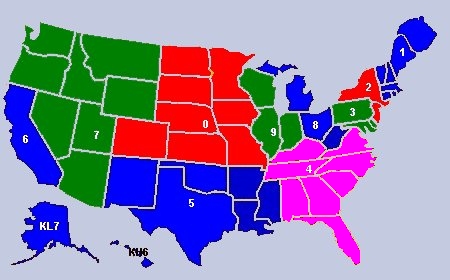
Ham radio callsigns originally were designed with a one or two letter prefix, a single number 0 (zer0) through 9 and a suffix of one, two or three letters. The FCC started with the single letter prefix "W" for all ham stations. The single numeric character was derived by dividing up the US into ten "call areas" based on census population. In the beginning, if you saw a callsign starting with "W4" you could be sure that this was an oldtimer whose station was in Alabama, Florida, Georgia, Kentucky, North Carolina, South Carolina, Tennessee or Virginia. Similarly a callsign starting with "W5" was for a station located in Arkansas, Louisiana, Missisippi, New Mexico, Oklahoma or Texas. That worked fine for a while.If you do the math, you'll find that in each call area 0-9 there could only be 18,278 ham licenses; for example, in the fourth call area there could only be W4A through W4ZZZ. And this would yield a maximum of 182,780 hams in the whole country.
Sometime in 1952-3 the FCC ran out of "W" callsigns nationwide. Their solution was to start using the "K" prefix which doubled the number of possible ham licenses. And when they ran out of "K" the decided to go back to "W" and add another prefix character before the number. This gave us "WA4AAA" through "WZ4AAA" -- and when they ran out of those they used "N" and then "AA" and so forth.
One of the reasons for proliferation of callsigns is that we are a mobile nation. When I moved from Arkansas (as K5AZL) to Georgia, I was required to get another callsign (Georgia is, remember, in the "4" call area) and I was assigned W4GKF. Sometime in the seventies or eighties the FCC realized that this was a lot of paperwork for everyone and was using up callsigns for no good reason. Today you can keep the callsign you have (regardless of the embedded number) when/if you move to a new home; so the number is no longer a "for sure" indication of where the ham is operating from.
In the early fifties, along came the Novice license class (where I started) and the FCC decided to inserted a "N" (for Novice) between the prefix and the area digit. I was originally licensed as KN5AZL; then, when I upgraded my license class to Advanced Class the FCC simply dropped the "N" and I became K5AZL.
And I think that's about enough of that subject!
For those interested in which states are in which call area: